Sport
Football (or Soccer as it's termed in the USA)
Here are Tips4U top ideas for improving your game:
Keep possession
If the other team haven't got the ball they can't control the game but your team can.
Practice passing and bringing the ball under control in all situations
Attack with commitment
When the opportunity is right and you can see an opportunity to catch the opposition off their guard make a committed, direct approach to attack their goal. When you see an opportunity (ie you have more players in good positions ahead of you), take the risk to try and get in behind them or play some interpassing with the commitment to get the ball forward rapidly and take a shot at goal.
Give more effort
Keep fit, get fitter, try harder. The more you put into your game, the more rewards you'll get from playing it. If you're an attacker when your team's on the attack find space to get away from a defender and make an opportunity for a team mate to get the ball to you with space for that strike on goal.
If you're a defender get back fast if the opposition raise a quick counter attack, keep yourself close and in control of who you've agreed to mark on the other team.
Midfielders will cover huge amounts of the pitch in supporting the attack and getting back in numbers to defend.
Goalkeepers nowadays can act as a last defender, they can get out to cover any over the top type attack. They need to be quick to perceive the long ball through and fleet of foot to beat the opposing attackers to the ball.
Stay alert
Don't forget, the opposition will be trying their hardest to get one step ahead of you to keep possession or make a break to attack. Stay focussed, keep concentrating on what you're doing when you have the ball and options for what to do with the ball. When you don't have the ball keep focussed on where you should be in any given situation to support an attack or being ready to defend one.
Have fun
Football is a game for all ages so whatever your age or sex and whatever level you play at (unless you're a top professional and not many of us are) enjoy yourself.
Tennis
Singles Tennis Strategy
Tennis isn’t all about hitting the ball as hard as you can with the hopes that your opponent can’t return it. The reality is, you won’t always have a perfect opportunity to hit a winner, as your opponent will be utilizing something you should be too: tennis strategy. In essence, tennis strategy is all about outplaying your opponent, using techniques that can either: set you up for a winner, or make it so that your opponent hits the ball out, hits the ball into the net, or simply can’t reach the ball. So, here is some basic singles tennis strategy you can apply to become a better player.
Your tennis strategy will often revolve around a certain type of style, although you are always free to change your play style whenever you want to respond to certain situations. The most common styles a player can use in tennis include the counter pusher, aggressive baseliner, all-court, and serve-and-volley. Mastering one style can help you play better, for sure, but learning all four can help you tremendously as you adapt to real-time situations and different opponents. Of course, the best way to learn tennis strategy is through first hand experience, as you’ll be able to improve naturally while discovering your preferences in play style.
|
Counter Pusher (Defensive Baseliner) 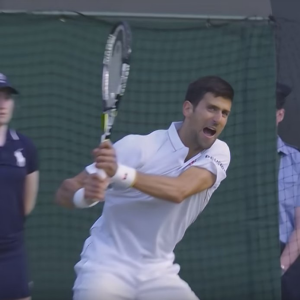 A counter pusher is basically a player who “pushes” back any shot, returning the right shot for whatever their opponent sends their way. The goal of this style of play is not to hit winners, but to strategically outlast your opponent until they make an unforced error. Counter pushers typically have a lot of stamina, and are very consistent, rarely making errors. As a counter pusher, you should think of yourself as a wall (minus the concrete and plaster, but with a touch of psychological warfare), with the sole objective of returning all your opponent’s shots. The tennis strategy used by counter pushers include:
|
|
Aggressive Baseliner 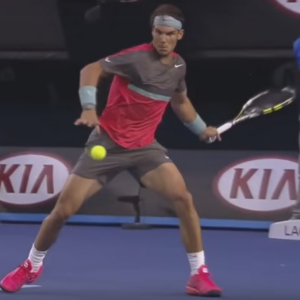 The aggressive baseliner spends most of their time at the baseline, winning most of their points there by playing aggressively.The goal is to hit hard and deep shots that land several feet back from the service line, which will overpower the opponent. Aggressive baseliners are not afraid to take big risks with a shot, but only when there’s an opening where they can put away easy balls or force the opponent to make an error. But while waiting for an opening, it’s common to hit the ball from side to side until one appears. These types of players are often armed with a very big serve as well, which helps to put them on the offense. The tennis strategy used by aggressive baseliners include:
|
|
All-Courter (All-Court Player) 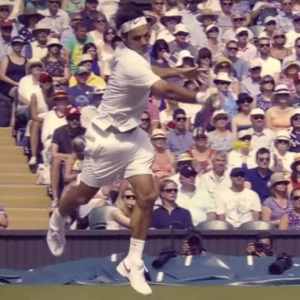 All-courters are very tricky tennis players, although the most versatile. These types of players don’t really have a shot that can be used as a weapon, instead relying on a variety of shots and incorporating aspects of every tennis style into their style of play. The goal of an all-courter is to keep the opponent guessing, using different shots and changing their approach to catch adversaries off-guard. As an all-court player, don’t be afraid of switching your game up if what you were previously trying wasn’t working. The tennis strategy all-court players use include:
|
|
Serve-and-Volley 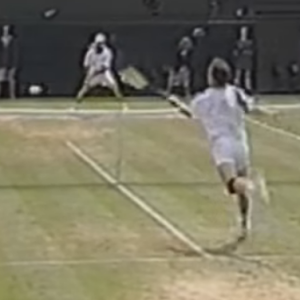 The serve-and-volley player is an aggressive type of player that rushes to the net as often as possible in order to put pressure on the opponent. Being agile and good at the net are common characteristics of serve-and-volley players. This style of play is not used as much as it used to be because of the evolution and improvements of the tennis racquet, which gives players a better chance of hitting balls deep and hard. It is also a difficult style to master against other types of players, although it is an effective tennis strategy against counter pushers. This makes it difficult for serve-and-volley players to return those types of shots. The tennis strategy serve-and-volley players use include:
|
Golf
Top Golf Tips for Beginners
Here at Tips4U we think golf is a great sport and can be played alone or with friends giving much pleasure and good old fresh air and exercise.
Tip No. 1 - Take Straight Aim
Not just for your feet but also your knees, hips, shoulders and club face. Most right-handed golfers aim right but this doesn’t always mean the ball will go right as often their swing will compensate for poor alignment. Check your alignment every practice session for the rest of your life!!
In the first part of this set up guide, we’ll look at proper golf alignment…
Even though most amateur golfers understand the importance of lining themselves up correctly on the golf course (and have a fair idea what it consists of), we still see alignment issues in the majority of players we meet. There are 2 reasons for this:
- They have altered their stance and address position to try and compensate for a fault in their golf swing (such as a slice).
- They simply fail to check their alignment on a regular basis and bad habits quickly creep in.
In this article and video, we’ll recap what proper alignment consists of. We’d also like to offer you some tips and advice for maintaining a great set up position throughout your golfing career.
Golf Alignment Key Points
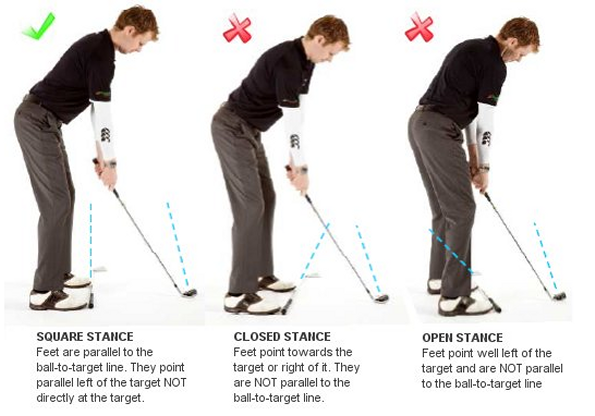
- A consistent golf swing and a consistent golf game can only be built on proper alignment. Don’t try and correct faults in your game before addressing this issue.
- To check your alignment, pick a target in the distance and set up to the ball as normal. Place a club along the line of your toes, step back and see where the club points:
- If the club points directly at the target, or to the right of the target, your stance is what we call closed.
- If the club points way left of the left of the target, your stance is what we call open.
- The club should point parallel left of the target (imagine the line along your feet and the line from the ball to the target are like 2 train tracks). This is a square stance.
- Remember – your knees, hips and shoulders should be in line or parallel to your feet. If you can, have a friend hold a golf club across your hips and then your shoulders while you are in the set up position. Step away and check where this club is pointing.
- Don’t forget the angle of the club face as you address the golf ball. This should be square (at right angles) to the ball-to-target line (see image below).

Make Good Golf Alignment Feel Like Second Nature
Proper alignment on the golf course isn’t a technically difficult subject – it’s common sense. But because it’s so basic, we think that’s why so many club golfers forget to check it on a regular basis.
Tour Pros check their own alignment every time they practice. It’s not too basic for them so it shouldn’t be for any other standard of golfer (who are more likely to fall into bad habits in the first place). Here are a few tips for ingraining great alignment into your game:
- Each time you visit the range, check the position of your feet, knees, hips and shoulders. Place a couple of clubs or alignment sticks along the ground as a visual reference.
- If possible, ask someone to stand behind you as you hit balls and ask them to check your hips and shoulders (as these are more difficult to check yourself).
- Standing behind the ball looking at your target, pick a mark a few feet in front of the golf ball that is directly on your ball-to-target line (it could be a leaf or a patch of dark grass for example). Set up as normal and imagine a line running from your ball to this mark. Adjust your feet, hips and shoulders so they are parallel to this line.
- Practice tip #3 with a spare club in the house or office 3-5x a day for 7-10 days. Run through the routine of standing behind your ball, picking a mark and lining up parallel to that mark. This can then become part of your pre shot routine on the golf course to ensure you line up to every shot correctly.
Tip No. 2 - Proper Golf Stance
Now that you’ve checked your alignment and have yourself pointing in the right direction, the next step is to build a proper golf stance…
A golf stance is made up of several elements – the right width of stance, the right amount of knee flex, the angle of the feet and overall posture.
A stance that is too narrow will prevent you from generating a lot of power in your golf swing. It will also make it difficult to keep your balance – which can severely compromise your ball striking.
But we see some golfers go too far the other way…
If your stance is too wide, you’ll find it difficult to shift your body weight during the swing (essential for power, timing and ball striking) and if you do, it will be more of a sway (something we want to avoid).
Golf Stance Key Points
- Widen your stance (insides of feet are 2-3 inches wider than shoulder width) for longer clubs such as fairway woods and the driver
- Reduce your stance width by an inch or two for short irons and wedges. For less than full shots (i.e. pitching and chipping, we don’t need a wide stance).
- Avoid pointing your toes out at too much of an angle. Your rear foot should be at right angles to the target line. Your front foot can be angled outwards but only slightly.
- Knees should be lightly flexed but not bent.
- Your body weight should be spread 50/50 between your toes and heels as well as 50/50 between your left and right foot for most shots.
Tip No. 3 - Correct Distance To The Golf Ball
So far in these golf set up tips, we’ve looked at your alignment and your stance. The next stage is to look at the distance you set up to the golf ball…
Because each club in the bag is a different length, our distance to the golf ball is going to change accordingly
In time, you’ll develop a natural feel for the correct distance with each club, but we’d like to give you a specific method to test you’re in a good position…
Distance To The Golf Ball Key Points
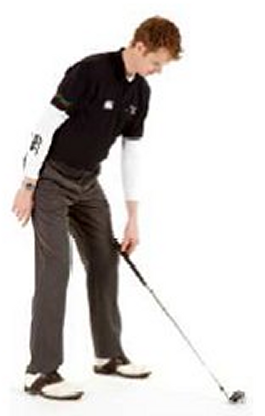
- Address the golf ball and lock your knees – so there is no flex in your knees at all. You should feel your weight shift towards your heels.
- Now, just flex your knees slightly until you feel your weight shift from your heels towards the balls of your feet. When you feel your weight is balanced over the centre of your feet, that’s enough knee flex.
- Take the chosen club and lower it onto your front thigh. The club should touch about 1 inch above your kneecap. If this doesn’t happen, alter your distance to the golf ball as necessary.
- Remember not to flex or straighten your leg to get the club resting an inch above the kneecap – you need to move your feet further or closer to the ball.
Tip No. 4 - Correct Golf Ball Position
In this tip4u, we’ll look at the correct golf ball position for each club…
Here we look at the ideal golf ball position between your feet, whether the ball should sit centrally between your feet or closer to your left or right foot.
The position of the golf ball actually changes depending on the club you’re using. The reason for this is that we want to slightly change the impact position and the launch conditions so that we get the best ball flight for the club in hand.
Golf Ball Position Key Points
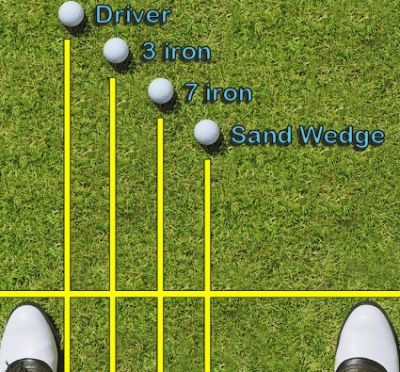
- Take your correct width of stance and place a club directly in the centre, at right angles to the ball-to-target line.
- This central position is the ideal position for the shortest clubs in your bag – lob wedge, sand wedge, gap wedge, pitching wedge etc. It helps you to hit down on the ball creating more backspin.
- For each longer club, the ball position should move roughly half an inch towards your front foot (left foot for right-handed golfers). So a 7 iron for example, would be played a couple of inches off centre, towards your front foot.
- The longest club in the bag, the driver, should be played just inside the front foot or opposite the left big toe (again for the right-handed golfer). This allows you to sweep the ball away rather than hitting down on it.
- The golf ball position should also move closer and further away from the body with each club – because each club is a different length. For a quick and easy method of positioning the golf ball the right distance from you, see the distance to golf ball tip above.
Tip No. 5 - Correct Hands Position
The position of the hands at set up, in relation to the golf ball, can help to determine the quality of your ball striking…
In the previous Tips4U of this golf set-up series, we’ve looked at the correct ball position for each club, and the ideal distance you should be standing away from the golf ball.
There’s one more checkpoint that we think a lot of golfers overlook (even lower handicap players) that you should incorporate into your set-up position. It’s to do with the position of your hands at address in relation to the golf ball. It’s a very simple tip but it can make a noticeable difference to your golf game.
Golf Hands Position Key Points
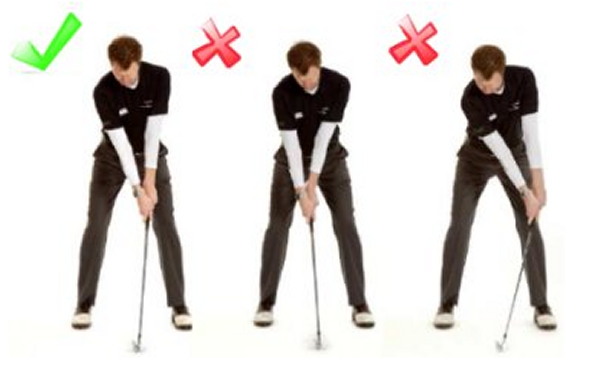
- To ensure that your set up mimics your impact position, point the butt end of the club at your front or left hip.
- Having the club held too far back may promote scooping. It can also cause you to hit the ball fat or thin
- Likewise, having the club held too far forwards would also result in inconsistent strikes and a ball flight that is too low.
Tip No. 6 - Correct Posture
Great golf posture is crucial for consistent, accurate and powerful ball striking.
You don’t have to be an athlete to achieve great posture over the ball and the tips in this section will work for golfers of all shapes and sizes.
The golf swing is essentially a turning motion around a central column – that central column being your spine. The better the position and the angle of your spine at address, the better it will be throughout the swing, especially at impact.
Now, different people will have different natural postures. Your posture might not be great while your sitting, standing or driving for example, but with a little bit of practice you can create a very efficient stance over the golf ball.
Golf Posture Key Points
Here’s how to correct a poor posture position (that is either slumped or too upright):

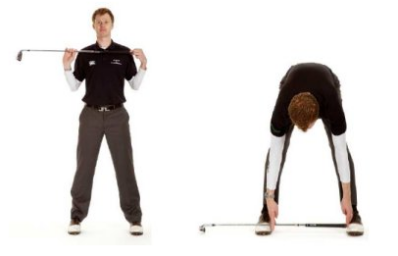
- Hold the club in front of your belly button with your arms and legs straight. Stand up tall with your shoulders pulled back and stick your chest out (photo #1).
- Tilt forwards making sure you tilt at the hips only. Your lower back should remain flat rather than rounded. Feel like you are pushing your behind backwards (Photo #2).
- As the club lowers to touch the ground behind the ball, flex your knees slightly (Photo #3). Avoid making the mistake of many amateur golfers by over-bending your knees.
Tip No. 7 - Proper Golf Grip
The importance of a proper golf grip is apparently one of the most written about topics in golf instruction. Yet still most golfers grip a golf club in a way that is costing them power, accuracy and consistency.
Remember, your grip is your only link to the golf club…
That golf ball you’re about to hit – it doesn’t react to what your swing looks like or how you’re standing or how long you’ve been playing golf…
All it reacts to is how fast the club is travelling, what direction the club is travelling in and the position of the clubface at impact.
All of those are controlled by how you grip the golf club.
Yes, changing your golf grip is uncomfortable at first and you might feel like you’ve taken a step backwards in the short term. But it’s well worth the small amount of effort it takes to make a proper golf grip feel second nature. You’ll play much more consistent, solid golf for many years to come as a result.
Proper Golf Grip Key Points
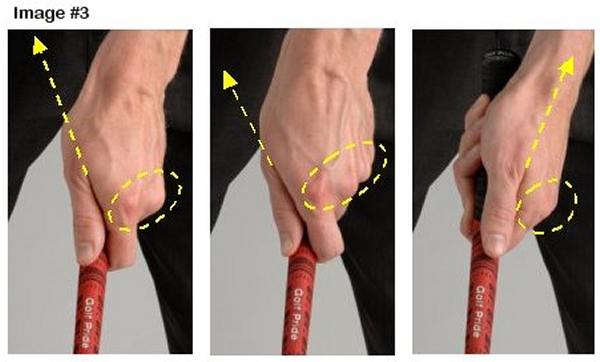
A correct golf grip will help you to achieve more distance, greater feel, better ball striking and more consistency with every club in your bag. Follow these steps for a great grip (reverse the instructions if you are left-handed):
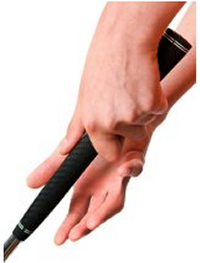
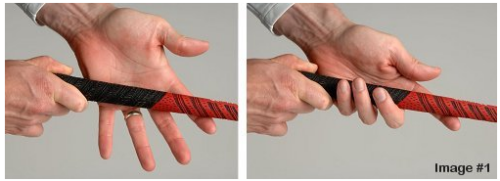
How to grip the golf club – Left Hand
|
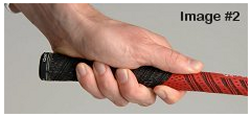
How to grip the golf club – Right Hand
- Place the fleshy pad of your right thumb directly on top of your left thumb.
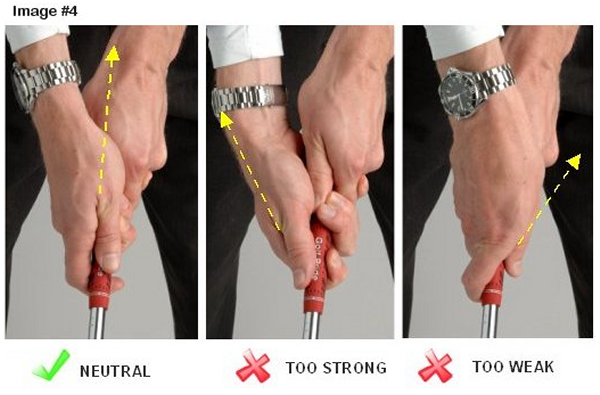
- The ‘V’ made between your right thumb and forefinger should point to your chin (see Image #4).
- If the ‘V’ points over your right shoulder, your right hand is in too strong a position.
- If the ‘V’ points over your left shoulder, your right hand is in too weak position.
Types of Golf Grip
There are 3 main golf grips:-
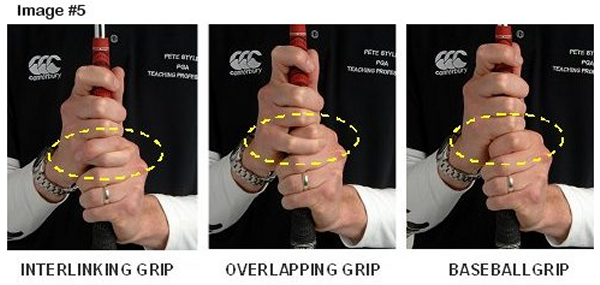
- The fingers of the right hand can grip the club and link with the left hand in 3 different ways – referred to as the interlinking grip, the overlapping or ‘Vardon’ grip and the baseball grip.
- It’s a common misconception amongst amateur golfers that the interlinking grip is predominantly used by ladies and juniors. Both Jack Nicklaus and Tiger Woods use the interlinking grip.
- We recommend you use either the interlinking or overlapping grip – whichever you find more comfortable.
Grip pressure – How hard should you grip the golf club?
|