
Health
Diet
Tips4U have the following main suggestions for a good way to eat.
1. Always eat breakfast
You've had a good sleep, now you need to fuel up for the day ahead. Make time to always have breakfast.
2. Eat a good varied diet
- plenty of fruit and vegetables
- plenty of starchy foods, such as bread, rice, potatoes and pasta
- some meat, fish, eggs, beans and other non-dairy product sources of protein
- some milk and dairy foods
- just a small amount of foods and drinks that are higher in fat and/or sugar
3. Get your 5 a day
Fruit and vegetables are a vital source of vitamens and minerals. It's advised we eat at least five portions of a variety of fruit and vegetables each day.
4. Starchy foods in your diet
Starchy foods should make up around one third of everything we eat. This means we should base our meals on these foods.
Potatoes are great (leave the skin on as well).
Choose wholegrain or wholemeal varieties of starchy foods, eg, brown rice, wholewheat pasta and brown or wholemeal bread. These have more fibre.
5. Protein
Meat, fish, eggs and beans are all good sources of protein.
Oily fish is really good.
6. Some "Don't does"
Avoid full fat varieties of milk and dairy products
Eat less fat and sugar. Most people eat too much fat and sugar.
Exercise
Tips4U have the following main suggestions for the best exercises you can do.
1. Swimming
You could call swimming the ideal workout. The buoyancy of the water supports your body and takes the strain off your joints so you can move them fluidly. Swimming is especially good for anyone with arthritis because it’s less weight bearing.
Research finds that swimming can improve your mental state and put you in a better mood. Water aerobics is another option. These classes help you burn calories and tone up.
2. Walking or Jogging
No need for a gym membership for this one, just get out of the front door and start walking. Getting out to new places and walking around is a great way to see diffent places and things and gets you exercising. And the faster you walk or jog the more benefits you'll get in building up your stamina
3. Riding a bike
It doesn't have to be the latest and greatest mountain bike or racing cycle, anything that's road worthy and comfortable will meet your needs. Build up your stamina gradually when you start (and your resistance to saddle soreness!). It's surprising how much ground you can cover in a relatively short period of time. Go out on your own, or even better get out with a group of friends (don't forget to always follow the rules of the road, or off road, wherever you go)
4. Join a Gym
Most gyms will have a mixture of equipment for cardiovascular training and strength training. Here at Tips4U we think a good mix of strength training and cardiovascular training is the best approach for health improvement. It's also a great way to meet new like minded people trying to get in shape or stay in shape.
The days of the gym being a young macho man's domain are no longer here, you'll get a good mix of men and women in the gyms of all ages.
5. Circuit training
A lot of gyms will run separate circuit training sessions. These are an excellent way to build up an advanced level of fitness. The instructors will normally push you along at a pace that they think the individual can work at. Go at your own pace to start with, it can be a little daunting surrounded by super fit people who have been doing it for years, but don't be put off by this.
Can’t Sleep? How to Recognize and Treat Insomnia
Tips4U have the following information on problems with sleeping.
Do you struggle to get to sleep no matter how tired you are? Or do you wake up in the middle of the night and lie awake for hours, anxiously watching the clock? Insomnia is a common problem that takes a toll on your energy, mood, health, and ability to function during the day. Chronic insomnia can even contribute to serious health problems. But you don’t have to resign yourself to sleepless nights. Simple changes to your lifestyle and daily habits can put a stop to insomnia—without the need for medication.
1. Understanding insomnia and its symptoms
Insomnia is the inability to get the amount of sleep you need to wake up feeling rested and refreshed. Because different people need different amounts of sleep, insomnia is defined by the quality of your sleep and how you feel after sleeping—not the number of hours you sleep or how quickly you doze off. Even if you’re spending eight hours a night in bed, if you feel drowsy and fatigued during the day, you may be experiencing insomnia.
Symptoms of insomnia can include:
- Difficulty falling asleep despite being tired
- Trouble getting back to sleep when waking up in the night
- Waking up too early in the morning
- Relying on sleeping pills or alcohol to fall asleep
- Not feeling refreshed after sleep
- Daytime drowsiness, fatigue, or irritability
- Difficulty concentrating during the day
2. Figuring out why you can’t sleep
In order to properly resolve your insomnia, you need to become a sleep detective. Emotional issues such as stress, anxiety, and depression cause about half of all insomnia cases. But your daytime habits, bedtime routine, and physical health can also play a major role.
Common causes of insomnia
Sometimes, insomnia only lasts a few days and goes away on its own, especially when the insomnia is tied to an obvious temporary cause, such as stress over an upcoming presentation or a painful breakup. Chronic insomnia, however, is usually tied to an underlying psychological or medical issue.
Psychological problems and emotional distress. Anxiety and depression are two of the most common causes of chronic insomnia. Other common emotional and psychological causes include chronic or significant life stress, anger, worry, grief, bipolar disorder, and trauma.
Medical problems or illness. Many medical conditions and diseases can contribute to insomnia, including asthma, allergies, Parkinson’s disease, hyperthyroidism, acid reflux, kidney disease, and cancer. Chronic pain is also a very common cause of insomnia.
Medications. Many prescription drugs can interfere with sleep, including antidepressants, stimulants for ADHD, corticosteroids, thyroid hormone, high blood pressure medications, and some contraceptives. Common over-the-counter culprits include cold and flu medications that contain alcohol, pain relievers that contain caffeine (Midol, Excedrin), diuretics, and slimming pills.
Sleep disorders. Insomnia is itself a sleep disorder, but it can also be a symptom of other sleep disorders, including sleep apnea, restless legs syndrome, and circadian rhythm disturbances tied to jet lag or late-night shift work.
Causes of insomnia you may overlook (and that are within your power to change!)
It’s important to identify all possible causes of your insomnia, including things you’re doing during the day or leading up to bedtime that interfere with quality sleep.
- Is your sleep environment noisy, too bright, or not very comfortable?
- Do you watch TV, play video games, or use a computer, tablet or smartphone in bed?
- Do you drink caffeinated beverages (coffee, tea, soda) within eight hours of bed?
- Do you keep an irregular sleep schedule?
- Do you exercise or eat late in the evening?
- Do you use alcohol to fall asleep?
3. Changing habits that disrupt sleep
If medical or emotional problems are contributing to your insomnia, treating them first is essential. But you also need to look at daytime habits and bedtime routines that contribute to sleeplessness.
Using a sleep diary to identify insomnia-inducing habits
Some habits are so ingrained that you may overlook them as a possible contributor to your insomnia. Maybe your Starbucks habit affects your sleep more than you realize. Or maybe you’ve never made the connection between your late-night TV viewing or Internet surfing and your sleep difficulties. Keeping a sleep diary is a helpful way to pinpoint habits and behaviors contributing to your insomnia.
Adopting new habits to help you sleep
Stick to a regular sleep schedule. Support your biological clock by going to bed and getting up at the same time every day, including weekends.
Avoid naps. Napping during the day can make it more difficult to sleep at night. If you feel like you have to take a nap, limit it to 30 minutes before 3 p.m.
Limit caffeine, alcohol, and nicotine. Stop drinking caffeinated beverages at least eight hours before bed. While alcohol can make you feel sleepy, it interferes with the quality of your sleep, and nicotine is a stimulant.
Avoid late meals. Try to avoid heavy, rich foods within two hours of bed. Fatty foods can take a lot of work for your stomach to digest and spicy or acidic foods can cause heartburn.
Get regular exercise. Regular exercise can improve the symptoms of insomnia, but it’s not a quick fix. It takes several months to feel the full effects. Aim for 30 minutes or more of activity on most days—but not too close to bedtime.
Develop a better bedtime routine
It’s not just what you do during the day that affects the quality of your sleep, but also those things you do to prepare your mind and body for sleep.
Make sure your bedroom is quiet, dark, and cool. Noise, light, and heat can interfere with sleep. Try using a sound machine or earplugs to hide outside noise, an open window or fan to keep the room cool, and blackout curtains or a sleep mask to block out light.
Avoid stimulating activity and stressful situations before bedtime. This includes vigorous exercise, big discussions or arguments, or catching up on work. Instead, focus on quiet, soothing activities, such as reading, knitting, or listening to soft music, while keeping lights low.
Turn off screens one hour before bedtime. The light emitted from TV, tablets, smartphones, and computers suppresses your body’s production of melatonin and can severely disrupt your sleep. Instead of emailing, texting, watching TV, or playing video games, try listening to a book on tape, a podcast, or reading by a soft light.
Coping with shift work
Working nights or irregular shifts can disrupt your sleep schedule. You may be able to limit the adverse impact with these tips:
- Adjust your sleep-wake cycle by exposing yourself to bright light when you wake up at night, using bright lamps or daylight-simulation bulbs in your workplace, and then wearing dark glasses on your journey home to block out sunlight and encourage sleepiness.
- Limit the number of night or irregular shifts you work in a row to prevent sleep deprivation mounting up.
- Avoid frequently rotating shifts so you can maintain the same sleep schedule.
- Eliminate noise and light from your bedroom during the day. Use blackout curtains or a sleep mask, turn off the phone, and use ear plugs or a soothing sound machine to block out daytime noise.
4. Neutralize sleep anxieties
The more trouble you have with sleep, the more it starts to invade your thoughts. You may dread going to sleep because you’re going to toss and turn for hours or be up at 2 a.m. again. Or maybe you’re worried because you have a big day tomorrow, and if you don’t get a solid eight hours, you’re sure to blow it. But agonizing about sleep only makes insomnia worse. Worrying floods your body with adrenaline, and before you know it, you’re wide-awake.
Learn to associate your bed with sleeping, not sleeplessness
Use the bedroom only for sleeping and sex. Don’t work, read, watch TV, or use your computer in bed or the bedroom. The goal is to associate the bedroom with sleep alone, so that your brain and body get a strong signal that it’s time to nod off when you get in bed.
Get out of bed when you can’t sleep. Don’t try to force yourself to sleep. Tossing and turning only amps up the anxiety. Get up, leave the bedroom, and do something relaxing, such as reading, drinking a warm cup of caffeine-free tea, taking a bath, or listening to soothing music. When you’re sleepy, go back to bed.
Move bedroom clocks out of view. Anxiously watching the minutes tick by when you can’t sleep—knowing that you’re going to be exhausted when the alarm goes off—is a surefire recipe for insomnia. You can use an alarm, but make sure you can’t see the time when you’re in bed.
It’s also helpful to challenge the negative attitudes about sleep and your insomnia problem that you’ve developed over time.
| Challenging self-defeating thoughts that fuel insomnia | |
|---|---|
| Self-defeating thought | Sleep-promoting comeback |
| Unrealistic expectations: I should be able to sleep well every night like a normal person. | Lots of people struggle with sleep from time to time. I will be able to sleep with practice. |
| Exaggeration: It’s the same every single night, another night of sleepless misery. | Not every night is the same. Some nights I do sleep better than others. |
| Catastrophizing: If I don’t get some sleep, I’ll tank my presentation and jeopardize my job. | I can get through the presentation even if I’m tired. I can still rest and relax tonight, even if I can’t sleep. |
| Hopelessness: I’m never going to be able to sleep well. It’s out of my control. | Insomnia can be cured. If I stop worrying so much and focus on positive solutions, I can beat it. |
| Fortune telling: It’s going to take me at least an hour to get to sleep tonight. I just know it. | I don’t know what will happen tonight. Maybe I’ll get to sleep quickly if I use the strategies I’ve learned. |
5. Tackle daytime stress and worries
Residual stress, worry, and anger from your day can make it difficult to fall asleep as night.
Get help with stress management.If the stress of managing work, family, or school is keeping you awake at night, learning how to handle stress in a productive way and to maintain a calm, positive outlook can help you sleep better at night.
Talk over your worries during the day with a friend or loved one. Talking face to face with someone who cares about you is a great way to relieve stress and stop you rehashing worries when it’s time to sleep. The person doesn’t need to be able to fix your problems, but just needs to be an attentive, nonjudgmental listener.
Harnessing your body's relaxation response
If you feel wound up much of the time and unable to let go of stress at the end of the day, you may benefit from relaxation techniques such as meditation, yoga, and deep breathing. Not only do relaxation techniques help you quiet your mind and relieve tension in the body, but they also help you fall asleep faster and get back to sleep more quickly if you wake up in the middle of the night. Some popular smartphone apps can help guide you through the different relaxation methods, or you can follow these techniques:
Abdominal breathing. Breathing deeply and fully, involving not only the chest, but also the belly, lower back, and ribcage, can help relaxation. Close your eyes and take deep, slow breaths, making each breath even deeper than the last. Breathe in through your nose and out through your mouth.
Progressive muscle relaxation. Make yourself comfortable. Starting with your feet, tense the muscles as tightly as you can. Hold for a count of 10, and then relax. Continue to do this for every muscle group in your body, working your way up from your feet to the top of your head.
Mindfulness meditation. Sit quietly and focus on your natural breathing and on the way your body feels in the moment. Allow thoughts and emotions to come and go without judgment, always returning to focus on breath and your body.
It takes regular practice to learn these techniques and harness their stress-relieving power. But the benefits can be huge. You can do them as part of your bedtime routine, when you are lying down preparing for sleep, and if you wake up in the middle of the night.
6. Getting back to sleep if you wake up
While it’s normal to wake briefly during the night, if you’re having trouble falling back to sleep, the following tips may help.
Stay out of your head. The key to getting back to sleep is continuing to cue your body for sleep. Hard as it may be, try not to stress over your inability to fall asleep again, because that only encourages your body to stay awake. A good way to stay out of your head is to focus on the feelings and sensations in your body or to practice breathing exercises. Take a breath in, then breathe out slowly while saying or thinking the word, “Ahhh.” Take another breath and repeat.
Make relaxation (not sleep) your goal. If you find it hard to fall back asleep, try a relaxation technique such as visualization, progressive muscle relaxation, or meditation, which can be done without even getting out of bed. Remind yourself that although they’re not a replacement for sleep, rest and relaxation still help rejuvenate your body.
Do a quiet, non-stimulating activity. If you’ve been awake for more than 15 minutes, get out of bed and do a quiet, non-stimulating activity, such as reading a book. Keep the lights dim so as not to cue your body clock to wake up. Avoid using electronic screens of any kind as the light they emit stimulates the brain.
Postpone worrying and brainstorming. If you wake at night feeling anxious about something, make a brief note of it on paper and postpone worrying about it until the next day when it will be easier to resolve. Similarly, if a great idea is keeping you awake, make a note of it and postpone thinking more about it until morning.
7. What about sleep aids and sleeping pills?
When you’re tossing and turning at night, it can be tempting to pop a pill for relief. However, no sleeping pill will cure the underlying cause of your insomnia, and some can even make the problem worse in the long run.
Dietary supplements for insomnia
There are many herbal supplements marketed for their sleep-promoting effects. Some remedies, such as lemon balm or chamomile tea, are generally harmless, while others can have side effects and interfere with other medications and vitamins you’re taking.
Two supplements for insomnia that are considered to be safe and effective are melatonin and valerian.
Melatonin is a naturally occurring hormone that your body produces at night. Melatonin supplements may be effective for short-term use, especially in reducing jet lag. However, there are potential side effects, including next-day drowsiness.
Valerian is an herb with mild sedative effects that may help you sleep better. However, the quality of valerian supplements varies widely.
Over the counter (OTC) sleep aids
The main ingredient in over-the-counter (OTC) sleeping pills is an antihistamine, generally taken for allergies, hay fever, and cold symptoms. Sleep experts generally advise against their use because of side effects, questions about their effectiveness, and lack of information about their safety over the long term.
Prescription sleeping pills
Prescription sleep medications may provide temporary relief, but can have serious side effects and make insomnia worse in the long run. It’s best to use medication only as a last resort, and then, only on a very limited, as-needed basis. Evidence shows that lifestyle and behavioral changes make the largest and most lasting difference when it comes to insomnia.
8. When to seek professional treatment
If you’ve tried the insomnia self-help strategies above and are still having trouble getting the sleep you need, a doctor or sleep disorder specialist may be able to help. Seek professional help for insomnia if:
- Your insomnia doesn’t respond to self-help
- Your insomnia is causing major problems at home, work, or school
- You’re experiencing scary symptoms like chest pain or shortness of breath
- Your insomnia occurs almost every night and is getting worse
Bring a sleep diary with you. Your doctor may be able to diagnose an illness or sleep disorder that's causing your insomnia, or refer you to a sleep specialist or cognitive behavioral therapist.
Cognitive behavioral therapy (CBT)
CBT is aimed at breaking the cycle of insomnia. Poor sleep tends to lead to stress and anxious thoughts about not being able to sleep. This in turn leads to stress and tension, which leads to poor sleeping habits, such as the use of sleeping pills. This leads to worsening insomnia and so on.
The Vicious Cycle of Insomnia
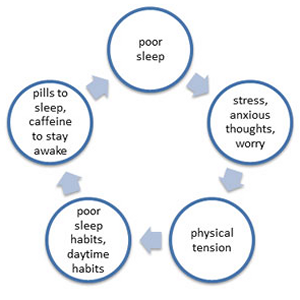 In addition to improving sleep habits, CBT is aimed at changing thoughts and feelings about sleep that may be causing stress and contributing to your insomnia. A therapist may also recommend sleep restriction therapy, whereby you initially shorten your sleep time. The idea is that by limiting the time you spend in bed to the number of hours you actually sleep, say from 1 a.m. to 6 a.m., you'll spend less time awake and more time asleep. As your sleep efficiency increases you'll gradually start going to bed earlier and getting up later until you reach your optimum sleep schedule. |
How to stop night time anxiety
Tips4U recently found the following article that we thought might be useful to people who suffer from anxiety and it affecting their sleep, which only goes on to make things worse.
It's been a long, tiring day and you're feeling shattered. Finally you crawl into bed, physically exhausted and ready for a good night's sleep… only to find your mind has other ideas. Instead of drifting off into weightless slumber, your brain fires up, your pulse quickens and your head becomes crowded with endless worries you thought had been parked for the day.
"Around 80% of people say their worries whirlwind out of control at night,'"says Nicky Lidbetter, chief executive of support group Anxiety UK. "With stress, we tend to worry about a specific, tangible problem. But with anxiety, we're less aware of what we're worrying about, so our reaction becomes the problem and we start feeling anxious about being anxious."
And even if we do initially drop off, those worries can still crowd in if we wake up during the night. "The classic time to wake up seems to be between 2am and 4am," adds Dr Nerina Ramlakhan, author of Fast Asleep, Wide Awake. "Suddenly your brain starts to became very active and problems that may well be solvable during the day become huge worries at night – made worse by the fact you can't sort them out there and then."
Here's what to do when your body says sleep but your mind's not listening.
1. Sleep by the clock
When it comes to sleep, timing is everything, as Dr Michael Breus reveals in a new book. Our circadian rhythm – also known as the biological clock – affects every aspect of our life, including our ability to sleep well.
The more we understand circadian dyssynchrony – when the biological clock is out of kilter – the better we sleep, so his theory goes. In The Power of When, Breus offers a programme for getting back in sync with our natural rhythm by making minor changes to our daily routine.
This initially involves taking a simple quiz to establish what kind of chronotype we are (Lion, Bear, Dolphin or Wolf). On the basis of which category you are, Breus then outlines how to schedule your day for peak productivity and wellbeing by timing when it's best to do everything – from eating and sleeping to going for a run and even having sex.
Going to bed at the correct bio-time means you won't lie awake feeling wired. Breus advises that lions (morning-orientated optimists with a medium sleep drive) should go to bed as close to 10pm as possible, bears (good sleepers who have a high sleep drive) at 11pm, dolphins (neurotic light sleepers with a low sleep drive) at 11.30pm and wolves (night-orientated extroverts with a medium sleep drive) at midnight.
2. Wind down, not up
Sleep is a natural physiological process – but you can help it along and avoid additional anxiety by having a set wind-down routine. The goal of this is to relax your body and prime it for sleep. So if you're going to bed at 10-11pm, set aside 30 minutes to an hour for an identical nightly pre-sleep routine. This may involve things such as taking a shower, washing your face and brushing your teeth, moisturising your face, putting on your PJs and climbing into bed with a book.
Psychologist Susanna Halonen says: "The more identical you can make every evening, the more you train your body to prepare for sleep and the easier it will be to achieve."
3. Keep a cork in it
"Alcohol is a stimulant as well as a sedative," says Dr Guy Meadows of The Sleep School. "While many people use it to fall asleep, it is also metabolised so quickly that it can leave the body craving more."
So when we drink alcohol close to bedtime, we are more likely to wake up in the early hours, leaving us primed for a night-time anxiety attack. As a rule of thumb, it takes an hour to process one unit of alcohol, so to be on the safe side, have a last glass of wine at 7pm if you intend to go to bed at 10pm.
4. Soak it up
Taking a relaxing bath can help declutter the mind. Try a few drops of an essential oil that contains lavender, which is a natural sleep aid. There's an added benefit to bathtime, too: the fall in body temperature we experience when we get out of the bath is a signal for the brain to start producing sleep-inducing melatonin.
5. Breathe and let go
Practising deep breathing can distract your mind from worries, explains Dr Ramlakhan. "Breathe in, hold for a few seconds and then breathe out – do this three times. Just follow the breathing as you do it."
Breathing in this way instantly slows everything down, relaxes the mind and body, and helps channel your energy into the breathing action. The breathing will give way to the tiredness, which will overcome anxiety and help you fall asleep.
6. Junk the caffeine
Avoid caffeine after 2pm, suggests Will Williams. "Caffeine is a powerful stimulant, and it takes six hours for our body to recover from a single cup of tea or coffee. If you feel you need a hit of caffeine to get you through the afternoon, then consider learning to meditate to give you more energy throughout the day."
7. Make your worries real
Write down what's on your mind at least an hour before bed. By committing thoughts to paper, you control them – they no longer control you and live on paper instead of in your head. Mentally, you can tick them off. Dr Meadows suggests giving each worry a nickname, too, such as The Nag.
"We can't help these thoughts coming in, but they're only a problem when they start to consume us,' he says. 'By giving them names, you speed up the process of defusion, so when unpleasant thoughts crop up, you can just acknowledge them – oh, there's The Nag again – and go back to what you're doing."
8. Get moving earlier
Strenuous exercise in the evening may cause your nervous system to be too wired to sleep, says meditation teacher Will Williams. So either restructure your day to exercise in the morning, or use meditation after exercise to calm everything down and bring you back into balance.
9. Set clear goals
Have a clear plan for the next day, says psychologist Susanna Halonen.
"If you know what priority number one and two are, you'll spend less time worrying because you know those are the first two things you'll get done. The more you turn this into a habit, the more you realise that if you plan ahead and prioritise effectively, the more easily you can get the important things done. This will lower your anxiety and help you sleep better."
10. Curb your cyberenthusiasm
If we're going to feel worry-free at night, it's crucially important to have a mental switch-off, says Neil Shah of The Stress Management Society.
"So have a digital blackout for an hour before bed, unplugging all devices that could stimulate the mind."
Boots pharmacist Tom Kallis adds that browsing the latest headlines online may feel like light relief, but it actually keeps your brain stimulated. He says: "If checking your phone is part of your end-of-day routine, do this at least half an hour before you turn the lights out so you give your eyes and brain a break. Put any electronics out of reach or on airplane mode so you won't be tempted to pick them up in the night – or if you can, turn them off completely."
LCD screens emit blue light, which is the same sort as sunlight, so playing havoc with our sleep hormones.
"Checking Facebook last thing at night is like shining a miniature sun into your eyes," says Dr Meadows. "Our body clock gets confused and starts thinking it's daytime again, so it inhibits the sleep hormone melatonin and releases the waking hormone cortisol."
11. Leave the room
If you simply can't get back to sleep because your head is buzzing with worry, don't look at the clock – you'll fret even more.
"Just get out of bed and go into another room for 10 minutes," says Dr Ramlakhan. "Leaving the environment you feel uncomfortable in breaks the association with worries. But don't start checking your phone or scrolling through Facebook."
Go into the living room and under a dim light read a few pages of a light-hearted book, or yesterday's newspaper. When you feel calm, return to your bed and begin some deep breathing again. She adds: 'Turn your pillow over when you get back into bed. It will feel cooler on your face and creates a separation from the last time you were lying there.'
This article was originally published in the December 2016 issue of Good Housekeeping.
Fearne Cotton's (UK Celebrity) battle with depression
She's known as a bubbly, blonde TV and radio host who always has a smile on her face, so it will be a surprise to many that Fearne Cotton was struck with depression . But the 35-year-old presenter, regularly seen goofing around with pals Holly Willoughby and Keith Lemon on ITV2 ’s Celebrity Juice, has opened up about her struggle with the illness, admitting that she took anti-depressants and has worked to rid her life of the “black” feeling. Now she wants to help others suffering with her “open, honest and vulnerable” book Happy.
 It was a few years ago that Top of the Pops star Fearne was struck down with debilitating symptoms that made her realise something was wrong. “I had a real lack of energy,” she recalls. “I felt so drained and my lust for everything that I love wasn’t there any more. “I’m very optimistic by nature, I wake up in the morning and I’m very excited about my day, I’m so pumped and enthusiastic about the smaller things in life and that was dead. "Everything was a drag and felt heavy. I felt anti-social, cut-off, alienated and they were massive warning signs. Everyone has that lightbulb moment that they need to do something differently, but for me it was feeling stuck.” Outwardly Fearne, who found fame 20 years ago presenting the Disney Club, has a dream life. She’s successful, married to Rolling Stone Ronnie Wood ’s 40-year-old guitarist son Jesse, and has two healthy children Rex, three, and Honey, one. At the time, Fearne was working as a mid-morning presenter at Radio 1, a post she left two years ago. “It was a tough time,” she admits. “But it was probably quite helpful, getting out the house, communicating with people, even if it is on a surface level and I think that slowly does help you. "My job became a hindrance and a help. It was very draining, but at the same time it was possibly helping me in the right direction. Having one thing that feels quite normal, when everything else is chaotic, is quite healthy.” Eventually, deciding her feelings were too much to cope with, seeing a doctor proved a turning point. Fearne reveals: “It was definitely a relief when the doctor identified what was happening to me. It took it away from being my fault. “I was prescribed anti-depressants. I decided it would get my head above the clouds for a moment. I’d never taken them before so it felt like it be worth a go.” She says she was only on the drugs for a short time – but it allowed Fearne to begin to get her head straight and consider other ways of coping with depression. She says: “Since writing this book, lots of people opened up to me about being prescribed anti-depressants. After a few months, I felt that I was able to start, very slowly coming off them and looking for other options.” Fearne was then able to review the way she was living her life and make some changes for the better, like cutting back on her social life “Letting go of ‘perfect’ was important,” she says. “I was trying to do so many things and putting so much pressure on myself – and why? Perfect doesn’t exist. I cut back a lot on work, and focused a lot more on family. “My priorities now are work and family, so going out and socialising are non-existent.” Fearne realised that depression ran in her family and talked with her mother Lyn, an alternative therapist, about her own battle. She says: “Before, mum didn’t want to burden me, wanting to be a strong figure. But having an open dialogue with my mum now has been massively cathartic.” Fearne thanks her husband Jesse, a guitarist in re-formed 90s band Reef, for being her rock. She says: “I’m exceptionally lucky that I met someone who’s so unbelievably free-spirited and curious about life and open-minded. He’s constantly a good soundboard and has a very positive outlook.” When she married Jesse three years ago, in a star-studded ceremony at Richmond Register Office, in South West London, she became stepmother to his two children – Arthur, 14, and Lola, 10 – with his first wife, model Catherine “Tilly” Boone, which she describes as “a huge learning curve”. She says: “I got really unselfish really quickly. Before, it was just me on my own worrying about whether I should do this job or not, then it became about loving other people and how we divide our time.” Despite her partying days in her 20s, Fearne is no longer a big drinker and Jesse is teetotal. She says: “My priorities way surpass going out and drinking. Our fun times are having dinner together, going to the cinema, it’s all about chatting, it’s not about getting off our heads and being crazy.” Fearne finds her father-in-law rocker Ronnie, 69, a constant source of inspiration and admires his boundless energy looking after his eight-month-old twin daughters, with his third wife Sally, 39. She laughs: “Just watching how Ronnie lives is really inspiring because his outlook on life is so optimistic and positive. Even though he’s still got two young kids he’s unbelievably energetic – it’s insane.” She says: “Before, I imagined life was about reaching the great heights of success, being respected. Really, the simplest, freest, happiest activities are running in the park, being with people I adore and dancing around the kitchen with my son and daughter to music.” |
14 THINGS PEOPLE WITH ANXIETY SHOULD UNDERSTAND
 ANXIETY DOES NOT DEFINE A PERSON
While many refuse to speak out about it, living with anxiety is an immensely difficult thing to do. The truth of the matter is that few non-sufferers comprehend how this illness affects people. In that light, here are just 14 things that people suffering from anxiety know to be true. This nugget of truth is perhaps one of the hardest things to explain to people who don't suffer from anxiety. Contrary to what some people may think, an anxious person is so much more than their mental state. The truth of the matter is that anxiety is not something that defines a person; it's a mental health disorder and ought to be treated as such.
 THE EFFECTS OF ANXIETY CAN BE PHYSICAL
Let's be clear: Even though anxiety is a mental health disorder, it's not just something that just affects your mind. Anxious feelings can manifest physically—sometimes severely. For example, someone suffering from anxiety may get uncontrollable panic attacks, headaches, dizziness, and an irregular heartbeat. To ease anxiety before these symptoms strike, try natural remedies for anxiety.
 TENS OF MILLIONS OF ADULTS SUFFER FROM ANXIETY IN AMERICA
In case you're thinking that anxiety is this small-time thing that only affects a few people, think again. There are a whopping 40 million adults in the U.S. alone, suffering from anxiety, according to the American National Institute of Mental Health. Since there still tends to be a stigma associated with the condition, it can be harrowing to admit that you're a sufferer.
 IN FACT, IT'S THE MOST COMMON MENTAL ILLNESS IN AMERICA
Many people believe that depression is the most common mental illness. Not so. Forty million adults in America suffer from anxiety, which makes up for 18 percent of the general population. That means there are more people suffering from anxiety than any other mental problem in America.
 JUST BECAUSE A FEAR IS IRRATIONAL, DOESN'T MEAN IT'S NOT REAL
Much of the time, what people worry about when they are suffering is something entirely irrational. Just because there is technically 'no need' to stress about a certain thing, that doesn't make the fear any less real. There's nothing more frustrating than being in the midst of a crippling panic, and someone explaining to you how very ludicrous your fears are. Shockingly, this tidbit of information does not help at all; if anything, it hinders.
 PANIC ATTACKS ARE COMPLETELY OVERWHELMING
While we're on the subject of panic attacks, let's talk about how they actually feel. Of course, everyone experiences these episodes in different ways, but there are some symptoms that every sufferer will recognize all too clearly. The surge of awful dread and fear comes over you out of nowhere. Suddenly, you're completely gripped by the sense that all is not well; something truly terrible is about to happen. You can barely breathe, you feel hot, your heart rate quickens, and you want to leave the place that you are. It physically hurts and you feel you have no control. And this barely scratches the surface of what it feels like to have anxiety.
 IF YOU HAVE ANXIETY, YOU MAY ALSO HAVE DEPRESSION
Here's the kicker: Many people who suffer from anxiety are also likely to suffer from depression. Scientists have found a biological link between the two mental illnesses, according to a study by the University of Western Ontario. That means that people currently living with anxiety may also have undiagnosed depression as well.
 THE MOST COMMON TIME FOR ANXIETY ATTACKS IS 9 P.M.
Here's a bizarre little fact, which perfectly illustrates how anxiety is biological rather than merely mental. The most common time that teens, in particular, report suffering from anxiety is at 9 p.m. That is according to a report from the Crisis Text Line. The information is based on how many texts the line gets throughout the day. Of course, there could be many reasons why people suffer the most at this time, but one explanation is that this is when certain chemicals are inactive in the brain.
 NO, YOU CAN'T JUST 'GET OVER IT'
As an anxiety sufferer, one of the most infuriating things you can hear is that you ought to simply 'get over' your illness. The challenging thing about living with anxiety is the fact that many people refuse to acknowledge it as a legitimate illness.
 ATTACKS CAN COME OUT OF THE BLUE
Many sufferers have so-called anxiety triggers, which often come before the onset of an attack. That's not to say that panic attacks have rhyme nor reason, though. In reality, attacks can come from nowhere; it's simply not possible to predict when or how they will raise their heads. In a sense, that's what makes suffering from this illness so difficult.
 NOT EVERYONE WITH ANXIETY GETS TREATMENT
The number of people getting regular treatment for their anxiety is shockingly low when you consider the fact that it's the most common mental illness in the U.S. In reality, only about a third of people suffering get the treatment they so desperately need, according to the Anxiety and Depression Association of America. The sad truth, then, is that two-thirds of sufferers are living under the shadow of this illness alone. If you suspect you're suffering from anxiety, it's crucial that you see a medical professional.
 IT'S NOT JUST A STATE OF MIND
The greatest and most problematic misconception about anxiety is that it's merely a state of mind; something that the sufferer can somehow control if they really wanted to. That idea is damaging simply because it places the blame of the illness on the shoulders of the sufferer. Instead, anxiety is something that you can learn to manage, but never fully control on your own.
 THERE ARE WAYS OF MANAGING IT
That being said, there are a few ways that you can manage anxiety. (These magic phrases to ease anxiety are a good start.) If you know what it feels like to have anxiety already, it's essential that you get the help you need. Each individual needs a different level of care, and your doctor will be able to help you determine the best course of action. People should not have to carry on living with anxiety without the help and support they deserve.
 SOMETIMES, IT'S THE STIGMA THAT HURTS THE MOST
The stigma of struggling with mental health issues is often what hurts and hinders the recovery process the most. There are many people out there who genuinely feel powerless over their illness since they don't want to actually admit they're a sufferer. It shouldn't be that way, and it doesn't have to be. As the solution so often is, the answer is education. For more advice, you can visit adaa.org.
Make Your Posture Perfect - Breathe Down Your Spine

Tips4U would like to ask you "Are you proud of your posture? Was your mum always telling you to sit up straight? Does she still nag you?".
We're on your mum's side! Most people do not pay enough attention to their daily posture and everyday movement habits, and it can have long-term health consequences if left unimproved. We've heard that you'll see postural issues every day in Yoga classrooms. We want to motivate you to make better choices to improve your carriage.
1. THE LINK BETWEEN BREATHING AND POSTURE
Despite her great advice, what your mum might not have realised is that your breath and posture are undeniably intertwined. Good posture cannot happen if the breath is trapped, restricted, or underused. But first, let’s get to the bare bones of “bad posture.”
Bad Posture: Holding your body structure inefficiently with respect to gravity as it relates to the task at hand in stillness or motion.
What’s more, your posture directly impacts the way your body breathes. Excess pressure on the body’s respiratory diaphragm and intercostal muscles alter the ability of those muscles to dynamically contract and lengthen to their fullest. Ever heard the term “chest breather”? This implies that a person is not fully using their diaphragm and has limited their breath’s movements to the rib cage, neck and shoulder muscles that kick in to help the body breathe when the diaphragm fails. A chest breather’s posture will alter over time to accommodate the habit of “bad breath.”Bad posture follows you around like a shadow. It shows up in the way you stand while cooking breakfast, waiting in line, or working at your desk, in your form while you exercise, within your yoga routines and even in the way you sleep. This shadow continues to grow more “shady” the more we ignore our body position. Our physical structure begins to adapt to our inefficient position and over time we can develop chronic aches and pains that are directly related to how we carry ourselves in the world.
On the flip side, simply slouching as a postural habit can give you shortness of breath, as can the habit of popping one hip out to the side all the time. As tension builds up in core and spinal muscles surrounding your breathing muscles, unwelcome spasms can occur that further alter the possibilities of a full breath.
That’s why improving your breath’s agility goes hand-in-hand with your postural ability.
2. REDEFINE YOUR SPINE: BREATHE INTO YOUR BACK
The spine is intimately connected with the respiratory diaphragm, and understanding their symbiotic relationship will help steer your posture improvement in the right direction. The diaphragm is a parachute-shaped muscle that lines the lower six ribs and the last six vertebrae of thoracic spine. (The thoracic spine has 12 vertebrae, all of which attach to ribs.) The diaphragm also hooks into the front side of most of the lumbar (low back) bones.
Organising these bones and toning the diaphragm helps rearrange the tension patterns of the spine from the inside-out and provides a more efficient lattice for the diaphragm to elongate and contract upon.
The following exercise targets the back of the diaphragm and the spinal bones and joints that connect with this most important breath muscle.
RIB ROCK
1. Lie on your back and place two grippy Yoga Tune Up® Therapy Balls (or you can substitute tennis balls) along the left side of the spine in the mid-back region.
2. Breathe slowly into the ribs and rock from side-to side and allow the balls to massage in towards the rib joints. Do this for 1-2 minutes on left side of spine, then switch sides. Next, move the balls slightly lower or slightly higher along the thoracic spine and ribs and repeat.
HOW IT WORKS
This exercise uncorks tension along the upper back and spine so that the spinal bones regain fluidity and mobility. This frees up trapezius, rhomboids, erectors and intercostal tension, mobilises rib joints, spinal joints, and posterior diaphragm rib connections, and massages deep back musculature.